A Washington Post interview with OKCupid co-founder and president Christian Rudder:
"There’s not a lot of romance on OKCupid, per se. That all happens afterwards. It all happens in real life."
Friday, October 31, 2014

Thursday, October 30, 2014
Caryl Churchill
I think the best place to start in terms of looking at the life and work of Caryl Churchill in a way that is interesting to us, is to note that she is;
1.) Still alive and actively writing
2.) Had Love and Information was published in 2012
Although it's clear that this is a contemporary text I think it's worth thinking about the fact that the text was written in a time that all of us were both alive for and cognizant of. Love and Information is very much a response to the society we function in.
However it is important to note that Caryl Churchill is much older than all of us. She is currently 76 so the age gap is pretty substantial for all of us. She is English and attended Lady Margaret Hall, a college of Oxford University that was an all women's college when she attended. She began writing as a college student and found her work well received. She is also noted as a very important and influential feminist play write.
A lot of her early work was written in the 1960's and 1970's and were radio plays for the BBC. What's interesting to me is that a lot these plays that she wrote for radio tested the technical limits of the medium. In her radio play, Identical Twins, she was adamant that the twins be played by the same actor. She insisted that each the dialogue between the two twins overlap at numerous points, a feat that was not easily accomplished over the radio in the 1960's.
However, in productions of her work in which she has been involved, she has proven herself nothing but collaborative. Since 1974 she has been a key artist in residence at the Royal Court Theatre (RCT) in London. A great deal of her work has been produced at RCT.
The last two points I'd like to note is that fact that Caryl Churchill does not give interviews. She has rather famously stated that the "plays speak for themselves". In this same vein when she is involved in a production of her work she is very collaborative but has definite boundaries as where she feels her input is absolutely not appropriate.
Allan Corduner, who has acted in several productions of Churchill's work, recalls a moment in which he struggled to find his character. He asked Churchill for guidance, she gently told him that it was not her role to give him meaning. While Churchill is collaborative and subjective when discussing her work she refuses to give actors and creators insight where she believes they must find their own.
Last thing, apparently she will write plays and appear with them. A long standing artistic direct of RTC once said that the RTC has never actually commissioned a play from Churchill. Instead she just appears with something new. Occasionally she'll write something new during a production of another one of her plays. Again she refuses to speak publicly about her work.
There's a lot to think about here, especially considering the work we're doing with Love and Information.
However it is important to note that Caryl Churchill is much older than all of us. She is currently 76 so the age gap is pretty substantial for all of us. She is English and attended Lady Margaret Hall, a college of Oxford University that was an all women's college when she attended. She began writing as a college student and found her work well received. She is also noted as a very important and influential feminist play write.
A lot of her early work was written in the 1960's and 1970's and were radio plays for the BBC. What's interesting to me is that a lot these plays that she wrote for radio tested the technical limits of the medium. In her radio play, Identical Twins, she was adamant that the twins be played by the same actor. She insisted that each the dialogue between the two twins overlap at numerous points, a feat that was not easily accomplished over the radio in the 1960's.
However, in productions of her work in which she has been involved, she has proven herself nothing but collaborative. Since 1974 she has been a key artist in residence at the Royal Court Theatre (RCT) in London. A great deal of her work has been produced at RCT.
The last two points I'd like to note is that fact that Caryl Churchill does not give interviews. She has rather famously stated that the "plays speak for themselves". In this same vein when she is involved in a production of her work she is very collaborative but has definite boundaries as where she feels her input is absolutely not appropriate.
Allan Corduner, who has acted in several productions of Churchill's work, recalls a moment in which he struggled to find his character. He asked Churchill for guidance, she gently told him that it was not her role to give him meaning. While Churchill is collaborative and subjective when discussing her work she refuses to give actors and creators insight where she believes they must find their own.
Last thing, apparently she will write plays and appear with them. A long standing artistic direct of RTC once said that the RTC has never actually commissioned a play from Churchill. Instead she just appears with something new. Occasionally she'll write something new during a production of another one of her plays. Again she refuses to speak publicly about her work.
There's a lot to think about here, especially considering the work we're doing with Love and Information.
Wednesday, October 29, 2014
Virtual windows in airplanes..
Concept for a plane without actual windows, but the walls of the airplane are giant screens onto with the surroundings of the plane are live streamed, making one giant virtual window and the illusion that the walls are transparent...
http://mashable.com/2014/10/27/windowless-plane-oled/
Sunday, October 26, 2014
YouTube and Viral Videos: the way our impules shape new media
Kevin Allocca is the manager for YouTube Trends, a spot for tracking the latest viral videos -- and connecting to the
communities that make the parodies, tributes and reply videos that
circle the giant viral planets of the "YouTube-iverse." Here's his TED Talk:
http://www.ted.com/talks/kevin_allocca_why_videos_go_viral/transcript?language=en
NPR also held an interview with Allocca where he talks more about what YouTube as a medium and the way we interact with "viral" phenomena can tell us about this generation in society.
http://www.npr.org/templates/transcript/transcript.php?storyId=218923747
Both of these are interesting in the way they talk about and examine the internet, YouTube specifically, and the way in which we interact with it and the implications. It's also worth noting that these phenomena are being examined from the angle of someone ostensibly "outside the terrarium", examining and creating data based on the way we all interact and respond to stimuli within the world of the internet.
http://www.ted.com/talks/kevin_allocca_why_videos_go_viral/transcript?language=en
NPR also held an interview with Allocca where he talks more about what YouTube as a medium and the way we interact with "viral" phenomena can tell us about this generation in society.
http://www.npr.org/templates/transcript/transcript.php?storyId=218923747
Both of these are interesting in the way they talk about and examine the internet, YouTube specifically, and the way in which we interact with it and the implications. It's also worth noting that these phenomena are being examined from the angle of someone ostensibly "outside the terrarium", examining and creating data based on the way we all interact and respond to stimuli within the world of the internet.
Tuesday, October 21, 2014
Hyperlinks, the Internet and Memory
Here's an interesting article that I was reading the other day. I thought it was especially relevant since we've been linking each other to other articles and media even just on this blog. The concept of "cognitive overload" also feels especially relevant to the work we were doing with 'Manic' on Sunday.
http://www.wired.com/2010/05/ff_nicholas_carr/all/
I'll post a longer entry about this and stuff other things related to technology and memory a little later this week.
Marisa
http://www.wired.com/2010/05/ff_nicholas_carr/all/
I'll post a longer entry about this and stuff other things related to technology and memory a little later this week.
Marisa
Tuesday, October 7, 2014
universe is possibly a simulation, existential crisis ensues
I'm transferring this from the Facebook group because it might have some dramaturgical uses...
(and it's just really cool)
Here is the article that came up on my Facebook feed:
Physicists May Have Evidence Universe Is A Computer Simulation
The HuffPost article is a little dramatic and sensationalist, so I looked for a more "science based" article and found something from the MIT Review:
The Measurement That Would Reveal The Universe As A Computer Simulation (published in 2010)
Imagine that our entire cosmos is running on the engine of a massive computer with "robotic overlords" ...
woah
(and it's just really cool)
Here is the article that came up on my Facebook feed:
Physicists May Have Evidence Universe Is A Computer Simulation
The HuffPost article is a little dramatic and sensationalist, so I looked for a more "science based" article and found something from the MIT Review:
The Measurement That Would Reveal The Universe As A Computer Simulation (published in 2010)
Imagine that our entire cosmos is running on the engine of a massive computer with "robotic overlords" ...
woah
Monday, October 6, 2014
Are you what you search?
On Katharine Clark Gray's User 927:
http://featuresblogs.chicagotribune.com/technology_internetcritic/2008/06/user-927-play-b.html
For more on the AOL incident:
http://en.wikipedia.org/wiki/AOL_search_data_leak
On the incident and Thelma Arnold, one of the individuals identified through her search queries:
http://www.nytimes.com/2006/08/09/technology/09aol.html?pagewanted=all&_r=0
A link to User 927's search history can be found here (WARNING, what is listed are the keywords used for the searches and many of these searches are disturbing and potentially triggering as they contain material related to rape, child pornography, and incest among others):
http://www.businessinsider.com/aol-user-927s-entire-sordid-search-logSunday, October 5, 2014
Fan Following vs. Cult Following (and the internet)
When does being just a "fan" of someone turn into something more like a cult following?
On the playground in elementary school, kids would tell this "scary story" over and over and over again in hushed voices by the kickball line-
that one kid thought Spongebob Squarepants was real and walked into the ocean to find his pineapple and drowned.
I scoured the Internet for proof if this actually happened or if something similar happened, but the internet's a strange, multivariate place, and the jury's still out. Some people say it's true and totally happened in 2002. Other's call it an urban myth.
Whether or not anyone drowned trying to find Spongebob, at the core of this incident is the belief that someone else's fiction can become someone else's truth. That something so removed from our reality can hold so much sway over our actions.
On an ABC News special "Out of the Woods"(which aired about a week ago), they covered an incident in which two twelve year old girls led their friend into the woods and stabbed her with intent to murder, trying to please the fictitious, elusive internet meme/video game character "Slender man". This actually did happen and the girl miraculously survived the stabbing. The two girls cited that they had to kill their friend in order to find Slender man's house in the woods. Through online chat rooms and websites, they started "serving" this faceless internet being, and fulfilling his requests. What the ABC News team gleamed from this incident was that "us parents" needed to monitor our children's internet usage more vigilantly. What sites are our kids going on? What kinds of evil are they witnessing? What is the internet making them do?
In this extreme incidence of fandom, these young girls resemble members of a 20th century cult, more than members of a neighborhood fan group. A cult whose leader could get his followers to kill, or kill themselves for him. Dozens of cults in the 20th century succeeded in creating such an environment in which it's members were pushed towards such extremes.
You can't ignore that both of these incidents involve people who are young. They're kids. They are "young, impressionable youth", who supposedly can't tell the real from the fake. (Don't let your kids play violent video games because you kids will become killers). Maybe. I'd like to think that they're something going on with fan culture itself in the 21st century that is making environments or niches for these kinds of manipulations to occur.
I know the "Fan" scene could be going in a different direction - but it reminded me so much of these two incidents.
The scene builds an image of a person from an aggregate of trivial facts. Who this person actually is, is less important than who these girls think "he" is. And this creation of a false identity, which is hyper real to the "fangirls", seems dangerous and powerful. When they can't get it right, and they can't remember what his favorite smell is, the construction of this person is halted, and the person real to them threatens to become foreign and fake - out of their reach. It's a world teetering moment.
the 20/20 story
I could link you to a forum of people arguing for almost a decade if the Spongebob thing happened or not - but I don't think you want to go there.
On the playground in elementary school, kids would tell this "scary story" over and over and over again in hushed voices by the kickball line-
that one kid thought Spongebob Squarepants was real and walked into the ocean to find his pineapple and drowned.
I scoured the Internet for proof if this actually happened or if something similar happened, but the internet's a strange, multivariate place, and the jury's still out. Some people say it's true and totally happened in 2002. Other's call it an urban myth.
Whether or not anyone drowned trying to find Spongebob, at the core of this incident is the belief that someone else's fiction can become someone else's truth. That something so removed from our reality can hold so much sway over our actions.
On an ABC News special "Out of the Woods"(which aired about a week ago), they covered an incident in which two twelve year old girls led their friend into the woods and stabbed her with intent to murder, trying to please the fictitious, elusive internet meme/video game character "Slender man". This actually did happen and the girl miraculously survived the stabbing. The two girls cited that they had to kill their friend in order to find Slender man's house in the woods. Through online chat rooms and websites, they started "serving" this faceless internet being, and fulfilling his requests. What the ABC News team gleamed from this incident was that "us parents" needed to monitor our children's internet usage more vigilantly. What sites are our kids going on? What kinds of evil are they witnessing? What is the internet making them do?
In this extreme incidence of fandom, these young girls resemble members of a 20th century cult, more than members of a neighborhood fan group. A cult whose leader could get his followers to kill, or kill themselves for him. Dozens of cults in the 20th century succeeded in creating such an environment in which it's members were pushed towards such extremes.
You can't ignore that both of these incidents involve people who are young. They're kids. They are "young, impressionable youth", who supposedly can't tell the real from the fake. (Don't let your kids play violent video games because you kids will become killers). Maybe. I'd like to think that they're something going on with fan culture itself in the 21st century that is making environments or niches for these kinds of manipulations to occur.
I know the "Fan" scene could be going in a different direction - but it reminded me so much of these two incidents.
The scene builds an image of a person from an aggregate of trivial facts. Who this person actually is, is less important than who these girls think "he" is. And this creation of a false identity, which is hyper real to the "fangirls", seems dangerous and powerful. When they can't get it right, and they can't remember what his favorite smell is, the construction of this person is halted, and the person real to them threatens to become foreign and fake - out of their reach. It's a world teetering moment.
the 20/20 story
I could link you to a forum of people arguing for almost a decade if the Spongebob thing happened or not - but I don't think you want to go there.
The Brainbow! Amazing beautiful neuron mapping
BRAINBOWS.
This is a technique developed by some people at Harvard to map neuron pathways in the brain. They used mice in their experiements, here are some incredible pictures of what they found. They're called BRAINBOWS.
You can read more about the actual technique here:
http://jaxmice.jax.org/findmice/brainbow.html
or
http://cbs.fas.harvard.edu/science/connectome-project/brainbow
ahsafa


This is a technique developed by some people at Harvard to map neuron pathways in the brain. They used mice in their experiements, here are some incredible pictures of what they found. They're called BRAINBOWS.
You can read more about the actual technique here:
http://jaxmice.jax.org/findmice/brainbow.html
or
http://cbs.fas.harvard.edu/science/connectome-project/brainbow
ahsafa
Memory extended
This is a photo series called "memory extended" by Frances Berry in which she has taken old photographs and literally stretched and extended them out. I feel as if this practice of applying physical actions and tools to try and grasp and manipulate something ephemeral is really resonant in the play.
I also think the photos are really beautiful and harrowing.
check them out here:
http://www.whereisfrances.com/memex/
PIG LATIN
Here's a translation of PIG LATIN:
Ancay ouyay eakspay igpay atinlay?
Can you speak Pig Latin?
Hope that helps!
Ancay ouyay eakspay igpay atinlay?
Can you speak Pig Latin?
Hope that helps!
Saturday, October 4, 2014
Wednesday, October 1, 2014
The iPhone dilemma: live or record?
An interesting article that appeared in the NYTimes last week about the constant millennial question of whether to live a moment or record it through technology. This phenomenon can also be summed up in the phrase "pics or it didn't happen". The article focuses on a man who recorded what could have potentially been his last moments as an airplane engine combusted mid-flight. I really like the quote from Pope John Paul II (the foremost technology expert) about the use of technology, which "should simplify and improve the quality of life, but distract attention away from what is really important." Is it narcissistic to document something if it is with the intention of providing a record for others? Are our selfies empowering others to love themselves? Feels relevant to the conversation we had in rehearsal on Tuesday night.
Check out the article here.
P.S. I'm also really fascinated as to why this article appeared in the fashion & style section of the newspaper??
Check out the article here.
P.S. I'm also really fascinated as to why this article appeared in the fashion & style section of the newspaper??
A Side Note. . .
The cover image for Love and Information . . .

. . . looks suspiciously brain synapses firing

Or maybe not so suspiciously.
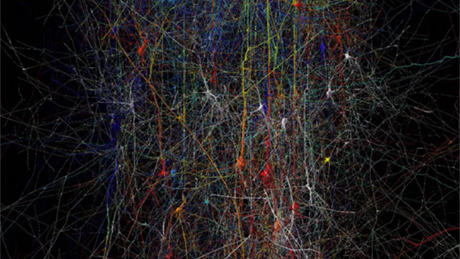
. . . looks suspiciously brain synapses firing
Or maybe not so suspiciously.
Biosphere 2
I know Biosphere 2 came up a while ago so I figured some background would be helpful, especially since we've been looking at terrariums.
Essentially, Biosphere 2 was suppose to replicate the all of Earth's major ecosystems. Biosphere 2 is the largest enclosed ecosystem in existence. It has a rainforest, an ocean with a coral reef desert, wetlands, a marsh, a savannah, as well as spaces for agriculture and human habitat. This huge structure is about 1/2 an hour north of Tucson, Arizona. A bit of an aside, the structure is called Biosphere 2 because the Earth itself is Biosphere 1.
The scientific community was enchanted with the idea of being able to have actual control over future experiments. Since the ecosystems within Biosphere 2 can be manipulated, researchers were fascinated with the prospect of being able to control factors within their experiments that were out of their power when experimenting on Earth. The general public initially saw Biosphere 2 as the first step to colonizing space. If a self sustaining replica of Earth could be built on Earth, what was stopping us from eventually doing the same on Mars?
The primary objective of Biosphere 2, past scientific research, was to see if a crew could survive with no outside intervention for a reasonable length of time. In 1991 a crew of 8 people entered the structure, their ability to sustain themselves would determine the success of the project. Researchers also included different species of mammals, insects and plants. The crew entering Biosphere 2 was expected to maintain their own food crop while cohabiting with the other animals, insects and plants.
The experiment was essentially a failure. Nearly every insect introduced was dead by the end of the two year long experiment, as were most mammals. Somethings, like cockroaches and morning glories, thrived in the environment. However their extraordinary ability to adapt to the environments of Biosphere 2 often came at the cost of the survival of other species. Biosphere 2 was not able to maintain balanced ecosystems without the aid of researchers on the outside.
As for the crew, within a few months of the experiment starting, they began to suffer from oxygen deprivation. While it was initially thought that the ecosystem was balancing itself out and this was part of the process, the oxygen levels dropped to the point where researchers had to intervene to keep the crew alive.
The lack of balance within the ecosystems mentioned earlier also made sustaining food crops much more strenuous than initially anticipated. Squabbles among those funding and running the experiment form the outside also contributed to the ultimate failure of what then referred to as"Mission 1".
There was one other short lived enclosure experiment that ended prematurely. Until 2007 Columbia University oversaw the structure and conducted research. Now it is in the hands of the University of Arizona who also uses it for research. The expense, grandeur, and failure of Biosphere 2 has left a distinct mark on the scientific community..
Essentially, Biosphere 2 was suppose to replicate the all of Earth's major ecosystems. Biosphere 2 is the largest enclosed ecosystem in existence. It has a rainforest, an ocean with a coral reef desert, wetlands, a marsh, a savannah, as well as spaces for agriculture and human habitat. This huge structure is about 1/2 an hour north of Tucson, Arizona. A bit of an aside, the structure is called Biosphere 2 because the Earth itself is Biosphere 1.
The scientific community was enchanted with the idea of being able to have actual control over future experiments. Since the ecosystems within Biosphere 2 can be manipulated, researchers were fascinated with the prospect of being able to control factors within their experiments that were out of their power when experimenting on Earth. The general public initially saw Biosphere 2 as the first step to colonizing space. If a self sustaining replica of Earth could be built on Earth, what was stopping us from eventually doing the same on Mars?
The primary objective of Biosphere 2, past scientific research, was to see if a crew could survive with no outside intervention for a reasonable length of time. In 1991 a crew of 8 people entered the structure, their ability to sustain themselves would determine the success of the project. Researchers also included different species of mammals, insects and plants. The crew entering Biosphere 2 was expected to maintain their own food crop while cohabiting with the other animals, insects and plants.
The experiment was essentially a failure. Nearly every insect introduced was dead by the end of the two year long experiment, as were most mammals. Somethings, like cockroaches and morning glories, thrived in the environment. However their extraordinary ability to adapt to the environments of Biosphere 2 often came at the cost of the survival of other species. Biosphere 2 was not able to maintain balanced ecosystems without the aid of researchers on the outside.
As for the crew, within a few months of the experiment starting, they began to suffer from oxygen deprivation. While it was initially thought that the ecosystem was balancing itself out and this was part of the process, the oxygen levels dropped to the point where researchers had to intervene to keep the crew alive.
The lack of balance within the ecosystems mentioned earlier also made sustaining food crops much more strenuous than initially anticipated. Squabbles among those funding and running the experiment form the outside also contributed to the ultimate failure of what then referred to as"Mission 1".
There was one other short lived enclosure experiment that ended prematurely. Until 2007 Columbia University oversaw the structure and conducted research. Now it is in the hands of the University of Arizona who also uses it for research. The expense, grandeur, and failure of Biosphere 2 has left a distinct mark on the scientific community..
Subscribe to:
Posts (Atom)